

Vyšehrad: Prague's Forgotten Fortress
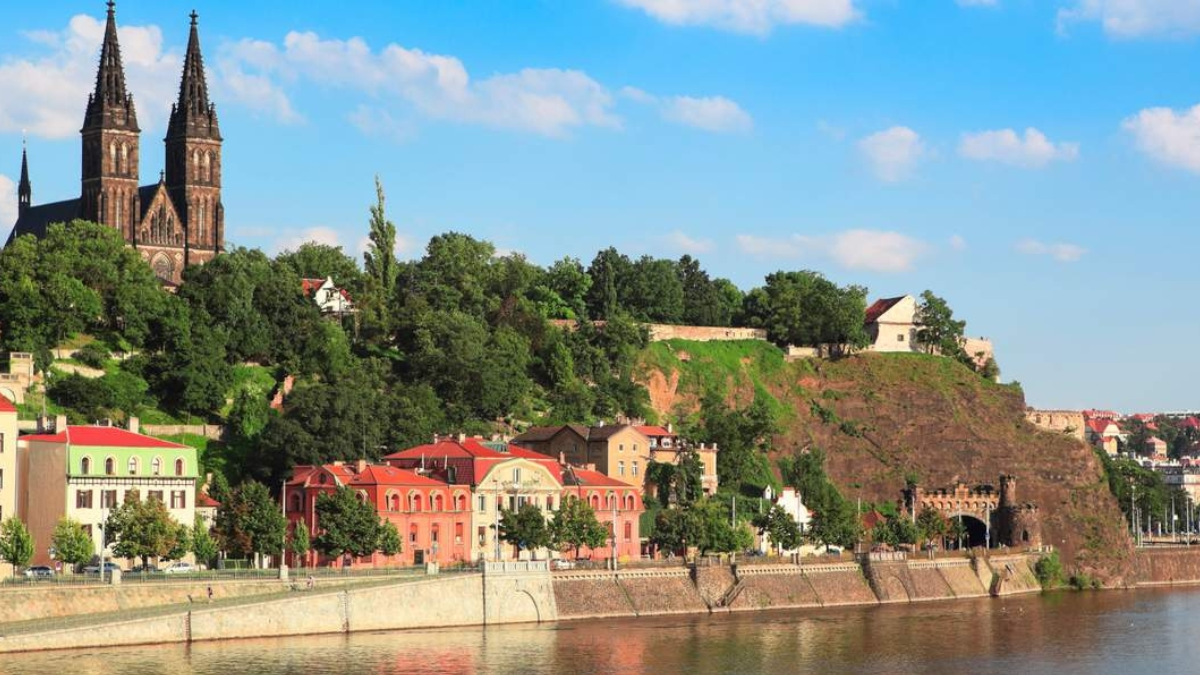
Vyšehrad is a historic fortress on a rocky cliff above the east bank of the Vltava River, approximately 3 km south of Prague Castle. Founded in the 10th century, it was briefly the royal seat of Bohemia under King Vratislaus II in the 11th century before yielding precedence to Prague Castle. Today it contains the neo-Gothic Basilica of St. Peter and Paul, the Slavín National Cemetery (where Antonín Dvořák, Bedřich Smetana, and Alfons Mucha are buried), Prague’s oldest Romanesque rotunda, and extensive views over the Vltava. From a river cruise, the cliff-top silhouette of Vyšehrad — fortress walls, twin church spires, and the bare rock face dropping to the water — is one of the most visually striking sights on the southern portion of the route.
Most visitors to Prague never reach Vyšehrad. It is not on the standard tourist triangle of Old Town Square, Charles Bridge, and Prague Castle. It requires a tram or metro journey and a walk. And yet it contains the graves of the greatest figures in Czech cultural history, the oldest Romanesque building in Prague, and some of the finest views of the Vltava from anywhere in the city.
From the river, though, Vyšehrad arrives without effort — the cliff-top fortress appears as the boat turns the southern bend of the Vltava, its rock face dropping directly to the water, the twin spires of the basilica visible above the fortification walls. For most river cruise passengers, this is their first and only view of Vyšehrad, and it is a compelling one.
The Legend: Princess Libuše and the Founding of Prague
Czech legend holds that Vyšehrad was the seat of Princess Libuše — a mythical ruler and seer who prophesied the founding of Prague from its cliff. The legendary quote attributed to her: “I see a great city whose glory will touch the stars.” From this height, looking north along the Vltava toward what would become Prague, she commanded the founding of the city and chose the ploughman Přemysl as her husband, founding the Přemyslid dynasty that ruled Bohemia for 400 years.
The legend is more complicated than it first appears. Archaeological excavations in the early 20th century found that the oldest settlement at Vyšehrad dates to the 10th century — not the mythological 8th century of Libuše’s era, and actually slightly later than Prague Castle. The legends were largely formalised and embellished during the 19th-century Czech national revival, when Vyšehrad was consciously reimagined as the cradle of the Czech nation. Some of the manuscripts used to support the legend’s antiquity were later found to be 19th-century forgeries.
None of this diminishes the power of the site. The cliff above the Vltava where the legends are set is genuinely dramatic. The statues of Libuše, Přemysl, and other Czech mythological figures by sculptor Josef Václav Myslbek (the same sculptor who created the St. Wenceslas statue on Václavské náměstí) stand in the fortress gardens. Bedřich Smetana’s symphonic poem Vyšehrad — the opening movement of his cycle Má vlast (My Homeland) — captures the romantic power of the site in music that generations of Czechs have grown up hearing.
The History: From Royal Seat to Baroque Fortress
Vyšehrad was likely founded in the 10th century as a fortified residence. Its zenith came in the late 11th century, when King Vratislaus II (Bohemia’s first king) moved his seat from Prague Castle to Vyšehrad and established it as the starting point of the Royal Road — the ceremonial route taken by Bohemian kings on their coronation day, running from Vyšehrad through the Old Town to Prague Castle. Charles IV later reinforced Vyšehrad’s symbolic status as the starting point of Czech royal history, though he himself lived at Prague Castle.
In the 14th century, Charles IV — seeking to legitimise the Přemyslid lineage and thereby his own authority — transformed Vyšehrad into a monument to Czech royal history. He rebuilt its walls and church, and confirmed its role as the ceremonial origin point of the Royal Road.
The fortress declined in importance over the following centuries and was severely damaged during the Hussite Wars. It was rebuilt as a Baroque military fortress in the 17th century under Habsburg rule, the form in which much of its surviving fortification dates. The Baroque fortification walls, the Tábor Gate, and the Leopold Gate all date from this period.
In the 19th century, Vyšehrad was transformed into a public park. The national cemetery was established in the 1870s, and it became the site of deliberate commemoration for Czech cultural figures at a time when Czech national identity was being consciously constructed under Austrian rule.
The National Cemetery: Where Czech Culture Is Buried
The Slavín National Cemetery at Vyšehrad is the burial place of Czech composers Antonín Dvořák and Bedřich Smetana, artist Alfons Mucha, writers Jan Neruda and Karel Čapek, and approximately 600 others who shaped Czech culture. It is one of the most significant cultural burial sites in Central Europe and one of the most moving places in Prague.
The cemetery was established in the grounds of the existing Vyšehrad churchyard from the 1870s onward, as part of the Czech national revival’s programme of honouring cultural heroes. The Slavín tomb — a collective monument for the most significant figures — dominates the central section of the cemetery. The individual graves of Dvořák and Smetana are among the most visited.
For anyone with an interest in Czech music, literature, or art, the cemetery is one of the most genuinely moving experiences in Prague. Unlike the tourist-dense sites of the Old Town, Vyšehrad cemetery is quiet, intimate, and rarely crowded.
What You See from the River
From the Vltava, Vyšehrad appears as a cliff-top silhouette — the rock face dropping directly to the water on the left bank, the fortification walls above, and the twin neo-Gothic spires of the Basilica of St. Peter and Paul rising above the walls. The view is most prominent on longer cruise routes (2-hour lunch cruise, night cruise with buffet) that extend south beyond the central city section.
The cliff-top position is immediately legible from the river. Unlike Prague Castle, which sits on a gradual hillside and is separated from the Vltava by the width of Malá Strana, Vyšehrad’s rock face drops almost directly to the water. Standing on the rampart walls at Vyšehrad and looking down at the Vltava makes the Horymír legend — of a knight leaping from the cliff on horseback into the river — immediately vivid, whatever its historical basis.
At night, the Basilica of St. Peter and Paul is illuminated, and the twin spires are visible from the river as the boat turns the southern bend. It is a less dramatic silhouette than Prague Castle’s Hradčany ridge, but more intimate — a single cliff-top church above a sheer rock face, with the dark river below.
The cruises that typically pass Vyšehrad include: – Vltava River Lunch Cruise — 2-hour route extending south to Vyšehrad and beyond – Vltava River Night Cruise with Buffet — 3-hour route passes Vyšehrad and the Smíchov lock – Prague City Highlights Vltava River Cruise — 75-minute panoramic route
Buy This TicketWhat Is at Vyšehrad Today
Basilica of St. Peter and Paul — The dominant structure on the cliff, a neo-Gothic rebuilding completed in 1903. The interior features original frescoes and the twin towers visible from the river.
Slavín National Cemetery — Open to visitors; admission free. The most significant cultural burial site in Bohemia.
Rotunda of St. Martin — Prague’s oldest Romanesque building, c.1100. Open on Mondays, Wednesdays, Thursdays, Fridays, and Saturdays at 6 PM for services.
The Casemates (Gorlice Hall) — Underground tunnels and chambers beneath the fortress, housing several of the original baroque statues from Charles Bridge (the outdoor statues are now copies). Entry fee approximately 70 CZK.
The Fortress Walls and Ramparts — Free to walk. The views from the southwest corner of the ramparts, looking north along the Vltava toward Prague Castle, are among the finest in the city.
Practical access: Metro Line C (red) to Vyšehrad station, then 10-minute walk to the Tábor Gate entrance. Or tram to Výtoň, then climb the steps to the Brick Gate (Cihelná brána).
Frequently Asked Questions
Is Vyšehrad visible from a standard Prague river cruise?
Yes — on cruise routes that extend south of the Dancing House. The cliff-top silhouette, the twin spires of the Basilica of St. Peter and Paul, and the sheer rock face above the river bend are all visible from the water. The Vltava River Lunch Cruise and Vltava River Night Cruise with Buffet both cover the Vyšehrad section.
Who is buried at Vyšehrad Cemetery?
Approximately 600 significant Czech cultural figures, including composers Antonín Dvořák and Bedřich Smetana, artist Alfons Mucha, writers Karel Čapek and Jan Neruda, and sculptor Josef Václav Myslbek (creator of the St. Wenceslas statue on Václavské náměstí).
Is Vyšehrad free to visit?
The fortress grounds and cemetery are free to enter. The Casemates (underground tunnels) charge approximately 70 CZK entry. The Basilica of St. Peter and Paul charges a small admission for interior access.
How do I get to Vyšehrad from the city centre?
Metro Line C (red) to Vyšehrad station, then 10 minutes’ walk to the Tábor Gate entrance. Alternatively, tram to Výtoň then climb the steps to the Brick Gate (Cihelná brána).
Is the legend of Princess Libuše historically accurate?
The legend as commonly told — Libuše founding Prague in the 8th century from Vyšehrad — is not supported by archaeology. The earliest settlement at Vyšehrad dates to the 10th century, later than Prague Castle. The Libuše narrative was largely formalised during the 19th-century Czech national revival as a founding myth, and some supporting manuscripts were later found to be 19th-century forgeries.
